Tax-aware rebalancing means trading back to target while limiting realized taxable gains. Set each account's tax rules and restrictions, choose which tax lots to sell, harvest losses where appropriate, and check wash-sale limits across related accounts before releasing trades. Apply the same rules to every account, and review exceptions by hand.
How to Run Tax-Aware Rebalancing Across RIA Accounts
Before You Rebalance: Tax Rules and Restrictions
Tax-aware rebalancing starts with settings, not trades.
Four items need to be on record for each account before anyone reviews drift:
- Account tax status. Taxable, tax-deferred, and tax-exempt accounts call for different handling. Realized gains and losses matter most in taxable accounts, so those accounts carry the tax logic
- Capital gains budget. The amount of realized gain the client is willing to take in a year. The budget limits how much a rebalance can sell from appreciated lots
- Restrictions. Securities the client will not buy or sell, ESG screens, and legacy or concentrated positions the firm is managing on purpose
- Household view. Which accounts belong to the same client or family. The wash-sale rule can reach beyond a single account, as the next section shows
If these settings live in a spreadsheet or in an advisor's memory, the process cannot run consistently. Enter them once, in the system that generates the trades.
Step-by-Step Tax-Aware Rebalancing Process
The steps below run in the same order for every account. The diagram shows the full sequence from drift review to trade release.
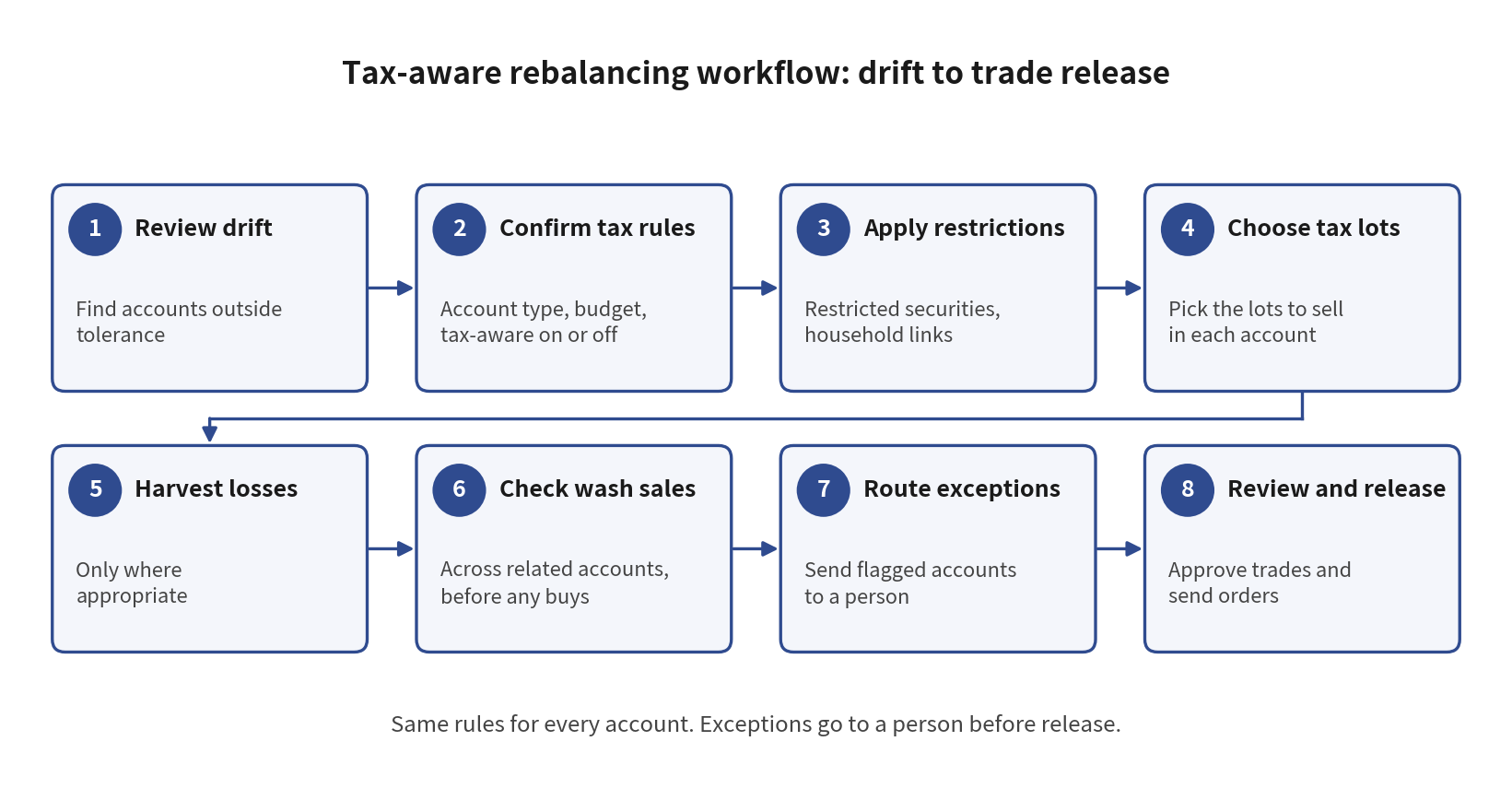
- Review drift. Sort accounts by distance from target and start with those outside tolerance. Every sale realizes a gain or loss, so trade only where drift justifies it
- Confirm tax rules. Check account type, capital gains budget, and whether tax-aware handling is on. Everything after this step depends on these inputs being current
- Apply restrictions. Load restricted securities and household groupings. Trades built without them have to be rebuilt later
- Choose tax lots. Select the lots to sell in each account. The lot chosen sets the gain or loss realized
- Harvest losses. Sell lots at a loss where the account's rules and budget allow it. A harvested loss only counts if it clears the next step
- Check wash sales. Compare planned buys and sells in the same or substantially identical securities across related accounts. A loss sale followed by a related purchase can disallow the loss
- Route exceptions. Send accounts that the standard rules cannot handle to a person. Forcing them through the rules is where errors start
- Review and release. Check the trade list, then send orders. Release is the last point at which a person can stop a trade
Steps 2 through 6 belong inside trade generation. If tax is applied by editing trades after they are built, the trade list no longer matches the target the rebalance was built to reach.
Choosing Tax Lots and Harvesting Losses
A tax lot is a block of shares bought at one time and one price. When an account holds several lots of a security, the lot sold decides the gain or loss realized.
Common lot methods include first in, first out (FIFO), highest cost first, and specific-lot selection, where the firm names the lots to sell. Tax-aware rebalancing uses specific-lot selection so lot choice follows the account's rules instead of a default order.
Illustrative example. An account must sell 100 shares of Fund X at $68. It holds three lots of 100 shares each. All figures are invented for illustration. The table shows the gain or loss realized if each lot is sold. It shows realized amounts only and does not estimate tax owed or any tax result.
| Lot | Bought | Cost per Share | Realized on 100 shares sold at $68 |
|---|---|---|---|
| 1 | 2019 | $40 | $2,800 gain |
| 2 | 2023 | $62 | $600 gain |
| 3 | March 2026 | $74 | $600 loss |
How the Wash-Sale Rule Limits Loss Harvesting
Loss harvesting is limited by the wash-sale rule. IRS Publication 550 states that a wash sale occurs when you sell or trade stock or securities at a loss and within 30 days before or after the sale you buy substantially identical stock or securities, acquire substantially identical stock or securities in a fully taxable trade, acquire a contract or option to buy substantially identical stock or securities, or acquire substantially identical stock for your individual retirement arrangement (IRA) or Roth IRA.
It adds that if you sell stock and your spouse or a corporation you control buys substantially identical stock, you also have a wash sale. Publication 550 says losses from a wash sale cannot be deducted, with an exception for dealers. Read the current publication, IRS Publication 550, Investment Income and Expenses, and confirm the rule with a tax professional.
In the example, suppose the same client's IRA is scheduled to buy Fund X in the same rebalance. A loss sale in the taxable account paired with a Fund X purchase in the IRA is the kind of pairing the rule's IRA language describes. Step 6 catches it by comparing sells and buys across the household before anything is released.
Harvesting that funds a move out of legacy holdings is a separate subject. Vestmark's tax-loss harvesting guide for RIAs covers it.
Handling Exceptions Across Accounts
Not every account fits the standard rules. Exceptions usually come from restrictions, legacy holdings, concentrated positions, and tax considerations specific to one client.
Routing works best when exceptions are flagged while trades are being generated and sent to a named reviewer with the reason attached. The reviewer decides whether to change the account's settings, edit the trades, or hold the account out of the rebalance.
Illustrative example. One model, one rebalance, three accounts. All details are invented for illustration.
| Account | Situation | Handling |
|---|---|---|
| A | Taxable account, $1,500 capital gains budget, no restrictions | Standard rules: lot selection within the budget, wash-sale check, release |
| B | The same client's IRA, scheduled to buy Fund X | Standard rules, plus the step 6 comparison, which holds this buy for review if Account A sells Fund X at a loss |
| C | Taxable account holding a concentrated legacy stock the firm does not plan to sell | Exception: routed to the portfolio manager before any trade is released |
How Does Trading Software Support This Workflow?
Software cannot supply the policy. It decides whether the policy runs the same way on every account. When evaluating trading and rebalancing software for this workflow, look for:
- Tax settings stored with the account. Account type, budget, and restrictions apply automatically every time trades are generated
- Lot selection inside trade generation. Tax decisions are made before the orders exist
- Wash-sale logic that looks across related accounts. Ask how the system identifies related accounts and whether accounts held elsewhere are covered
- Whole-account sessions. Many accounts rebalanced in one run, with the same rules applied to each
- An exception queue. Flagged accounts routed and tracked inside the platform
In Vestmark's platform, tax-lot selection, loss harvesting, and wash sale logic are part of trade generation as a rules-based process, so decisions are coordinated before orders are created. Restrictions, ESG screens, and tax budgets are enforced at the trade level across every account in a rebalancing session.
Whole-account sessions process accounts together, and exception-based management surfaces only the accounts that need attention. Vestmark's Trading and Rebalancing Software for RIAs guide sets out the evaluation criteria to test in a demo.
Firms that want tax management delivered as a service on top of their models can also look at Vestmark's Investment Advisory solutions, which include tax overlay.
See the Workflow in a Vestmark Demo
Tax-aware rebalancing across many accounts comes down to a repeatable order: set the rules once, apply them to every account, choose lots and harvest losses within those rules, check wash-sale limits across the household, and send exceptions to a person before release.
Get a demo to see how Vestmark generates tax-aware trades for RIAs and to test the workflow against your own accounts and rules.
Important Disclosures: This page is for general information. It is not investment, tax, or legal advice, and it does not address the circumstances of any specific client. Figures in the examples are invented for illustration and are not results. Platform capabilities and integrations vary by client configuration and custodian, and may change. Tax-aware trading strategies may be unable to fully realize strategic gains or harvest losses, and tax rules such as the wash sale rule limit loss harvesting. Optimization and rebalancing tools may estimate individual tax circumstances but cannot incorporate all individual tax information, which can lead to inaccuracies. Investing involves risk, including loss of principal; past performance does not guarantee future results. UMAs are not suitable for all investors.
This page describes a general process. It is not tax or legal advice, and it does not address any one client's situation.
FAQ
What is tax-aware rebalancing for RIAs?
Tax-aware rebalancing is rebalancing that takes tax rules into account when trades are built. It covers which tax lots to sell, how much gain to realize against a client's budget, and when to avoid triggering the wash-sale rule. The aim is to return accounts to target while limiting realized taxable gains.
How does the wash-sale rule affect rebalancing?
IRS Publication 550 says a wash sale occurs when you sell stock or securities at a loss and, within 30 days before or after the sale, buy substantially identical stock or securities. Purchases by a spouse or inside an IRA or Roth IRA can also count. A rebalance that sells at a loss needs to check for related buys before release.
How do RIAs choose which tax lots to sell?
Common methods are first in, first out, highest cost first, and specific-lot selection. In a tax-aware rebalance, the firm sets a rule for each account, such as staying within a capital gains budget, and the system applies it when building the sell orders. Whichever method is used, the choice should follow the account's rules and be documented.
Can tax-aware rebalancing run across many accounts at once?
Yes, if the platform supports it. Look for whole-account rebalancing sessions that apply the same tax rules to every account, and an exception queue that surfaces only the accounts needing review. Vestmark's platform processes accounts together in rebalancing sessions with exception-based management. Capabilities vary by client configuration, so confirm details in a demo.
What exceptions need manual review in a rebalance?
Accounts with restrictions, legacy holdings, concentrated positions, or client-specific tax considerations usually need a person to review them. So do accounts where a planned loss sale could collide with a related purchase. Route each one to a named reviewer with the reason attached, and record the decision for the next rebalance.